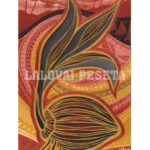

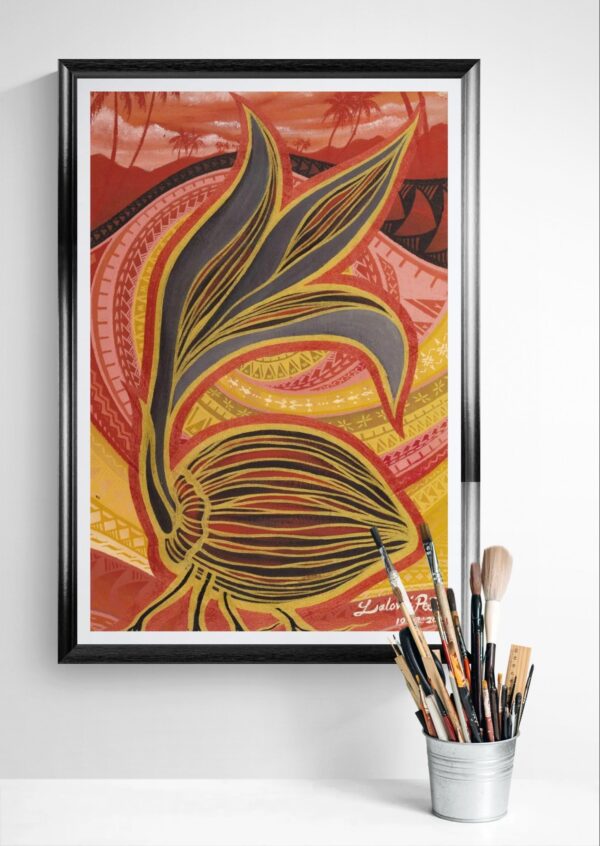


Popouli
T75.00
Price Summary
- T75.00
- T75.00
- T75.00
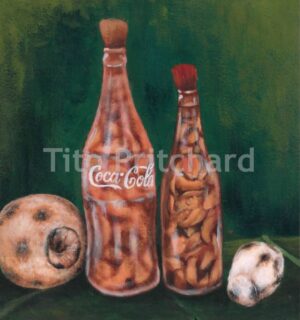
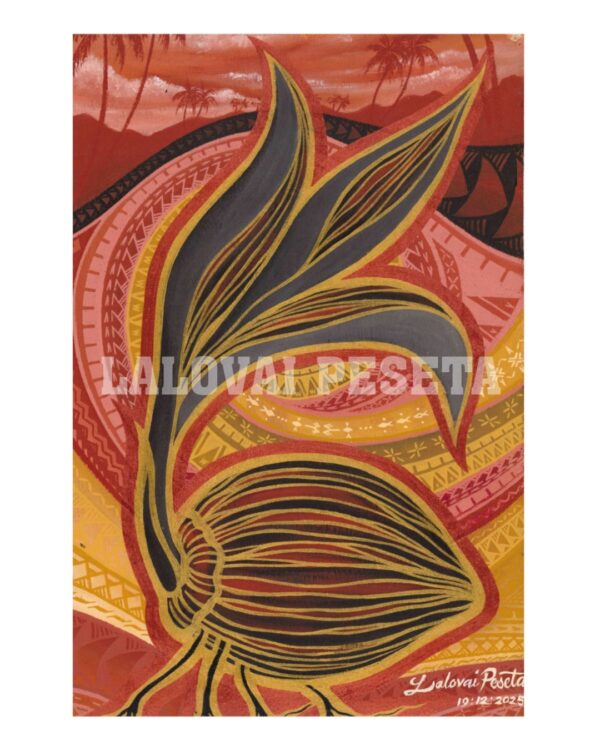
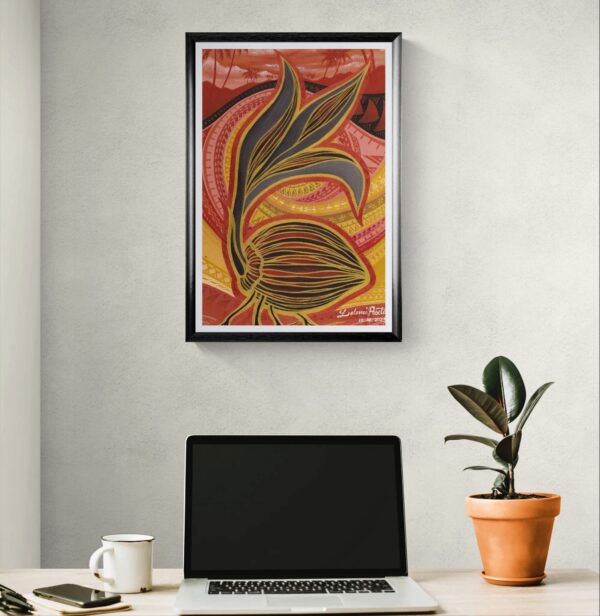
Popouli is a painting that uses the life stages of a coconut to represent the optimal timing for regrowth and regeneration.
Vendor Information
- Store Name: Lalovai Peseta
- Vendor: Lalovai Peseta
- No ratings found yet!
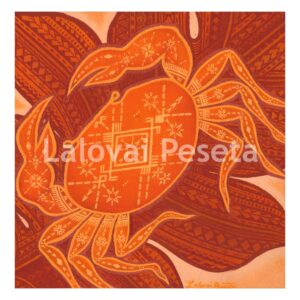
Pretty Crabby
This print by Lalovai Peseta features his signature style of tatau patterns and the monochromatic palette he does so well.
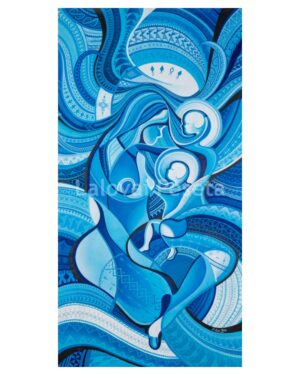
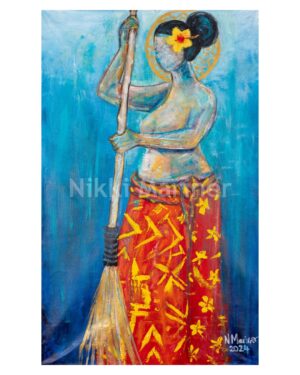
Pacific Blue Madonna
The original painting was exhibited and sold at the Regenerating Oceania Exhibition at the 13th Festival of Pacific Arts and Culture in Honolulu 6-16 June 2024.
This print is a deep statement about motherhood and the crucial role mothers have in sustaining society in Oceania.
Related Products
Fa’asamoa by William Mauola
This print by William Mauola includes ceremonial items of Samoan culture displayed in a tanoa against the background of tatau patterns.
It includes a nifo oti, ulafala, to’oto’o, fue and an aute/a red hibiscus.
The Editor
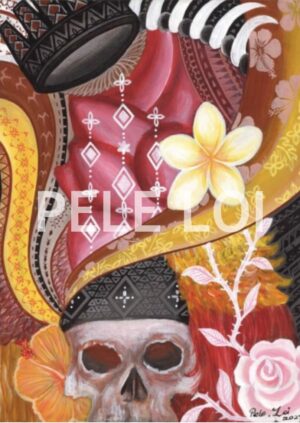
Internal chaos or forced deconstruction of identity? You decide.
Only $10 USD (approx currency conversion)
To’onai by Pele Loi
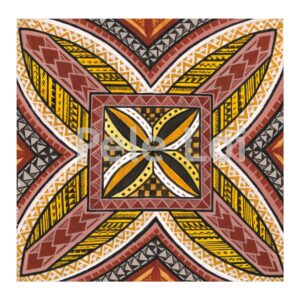
This print by Pele Loi depicts a traditional Sunday lunch including much loved Samoan food laid out on a plate of leaves against a background of tatau patterns.
Pacific Blue Madonna
The original painting was exhibited and sold at the Regenerating Oceania Exhibition at the 13th Festival of Pacific Arts and Culture in Honolulu 6-16 June 2024.
This print is a deep statement about motherhood and the crucial role mothers have in sustaining society in Oceania.
Memory of Flight
Musing on the paradox of permanence. What lasts? Bone? Or a butterfly’s brief beauty?
“Butterfly and Bone”
Only $10 USD (approx currency conversion).
Pretty Crabby
This print by Lalovai Peseta features his signature style of tatau patterns and the monochromatic palette he does so well.
Umu Feast by To’a Sāleilua
This print by To’a Sāleilua shows a steaming Samoan feast of pork, fish, breadfruit, taro and more, which are cooked using traditional methods.
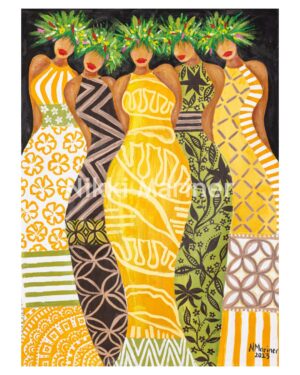
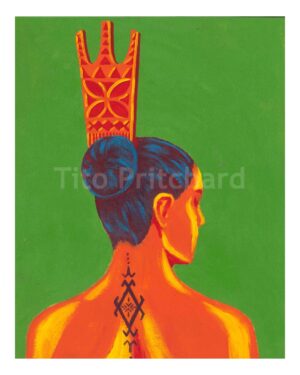
Me Time
This painting is about trying to capture the individual experience of looking inside for clarity and truth and looking outside for strength or inspiration.
I painted it as I was learning to meditate.
An unlikely sources of artistic inspiration in this depiction of a Samoan woman is mosque architecture.
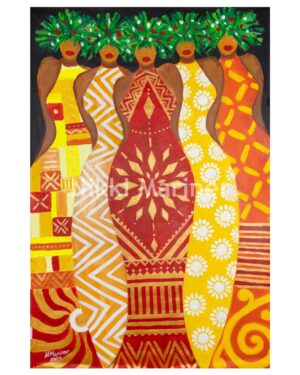
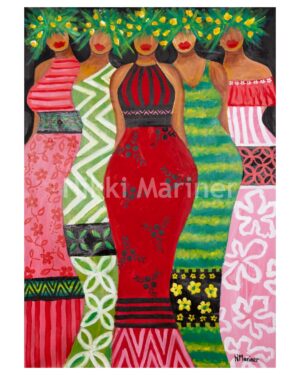
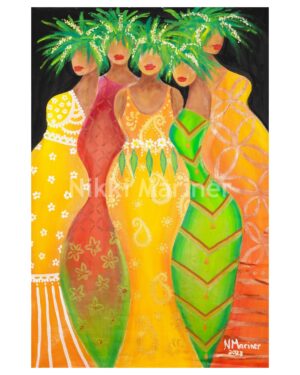
Mango Fandango
INSPIRATION
Mangoes are always special.
Fancy. Soft. Sweet. Round.
Celebratory and luxurious.
So this is what I infused in the figures, tones, and shapes.
It feels warm and sweet and happy.
I learned so much about mangoes doing this painting.
Eg.
🥭The paisley pattern on bandanas originates from mangoes.
🥭The leaves from a mango tree are believed to repel negative energy and attract prosperity and fertility in India where the mango is believed to originate.
ARTWORK
The starting point was the heads of the women, which followed an exact formation of mangoes hanging on a tree. Everything went from this point.
I used the colours of mangoes: orange, yellow, red, green, coral, purple. Tropical, sweet and glowy.
I used the curvy shapes of oval mangoes, long pointy leaves, and delicate long red stems laden with pale yellow tiny mango flowers.
Metallic colours of gold and copper added luxe and celebration.
This is the story of Mango Fandango.
(I used fandango in the sense of fun, party and dance).
Pisupo Pacific
This print features a favourite food in Samoa: Corned Beef or Pisupo.
Like artists for centuries, I teach myself about painting by doing my own versions of the great masters and modern icons.
Personally, I’ve never been attracted to the artwork by American artist Andy Warhol (1928-1987), but corned beef cans gave me the perfect opportunity to explore his work. Step into the experience of studying the minutiae of mundane objects and products.
It was interesting and it gave me a new appreciation.
Tanka
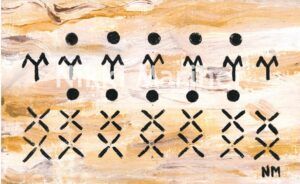
Playing with poem structure, paint, and Samoan markings.
Small paintings inspired by the 7 metre by 2 metre works (pic 6) I created for the VIP Terminal Lounge at Faleolo International Airport.
A tanka poem is derived from Japanese poetry arranged in five lines with a 5-7-5-7-7 syllable count.


There are no reviews yet.