
Experience vibrant, Pacific-inspired digital artworks from TalaSamoa.com—crafted to bring culture, color, and creativity to any space.
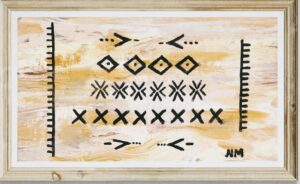
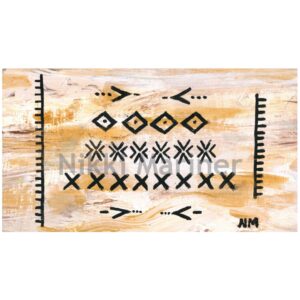
Cinquain
Playing with poem structure, paint, and Samoan markings.
Small paintings inspired by the 7 metre by 2 metre works (pic 6) I created for the VIP Terminal Lounge at Faleolo International Airport.
The cinquain poem was invented by an American poet, and she drew inspiration from Japanese forms such as haiku and tanka, which are arranged in five lines. The cinquain has a syllable count of 2- 4 – 6 – 8 – 2.
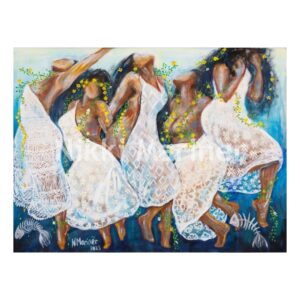
Cry Me A Moana
My sisters and I live different lives than we used to.
I watch their online stories traveling Europe and dancing at music festivals.
We discuss pending court cases and struggles of self-employment.
The days of desperately seeking babysitters, carpooling for school events, and borrowing from each other to pay the rent are gone.
We are less compliant and more calm.
We are more heartbroken and less cooperative.
We are smarter and deeper.
That’s what this painting is about.
Letting go. Floating.
I’ve always loved Ella Fitzgerald singing Cry Me A River.
The lyrics say it all. Cry me a river, I cried a river over you.
But the version that goes with this painting is Cry Me A River by Julie London, Live at the Americana Hotel, New York 1964. It’s breathtakingly beautiful.
So this painting is titled Cry Me A Moana and captures a similar sentiment as the song.
(Moana is a word that means ocean in several Pacific Island languages.)
Five brown-skinned full-bodied women floating in water.
They are reaching and twisting.
Their respectable white dresses become translucent, and the flower leis of honour are drifting away, and the women don’t care.
They float above fish skeletons and remnants of the past.
I hope it resonates. I want to make art that people feel, not only look at.
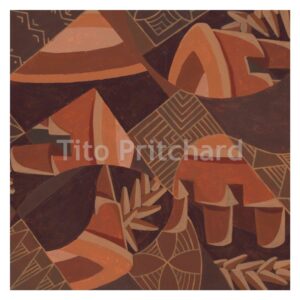
Cubist Tanoa by Tito Pritchard
This print by Tito Pritchard uses a cubism style to play with a tanoa and ula fala.
Daughters of the Waters
This print is from a series of three large paintings by Nikki Mariner, titled, ‘No Woman is an Island’.
Deep Down
DEEP DOWN
(2026)
A contemporary, sketch-like print of a new painting by Nikki Mariner.
Deep down. Feeling deep, feeling down.
Sometimes you need those days.
A small introspective piece.
Not much colour, lots of texture, and strong emotional impact.
One of three in this style and theme.
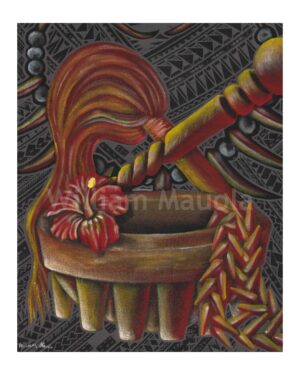
Fa’asamoa by William Mauola
This print by William Mauola includes ceremonial items of Samoan culture displayed in a tanoa against the background of tatau patterns.
It includes a nifo oti, ulafala, to’oto’o, fue and an aute/a red hibiscus.
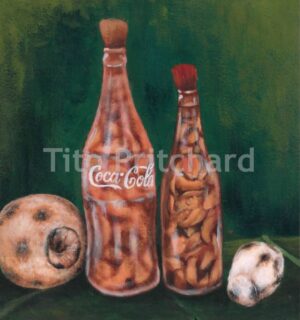
Fagu Sea by Tito Pritchard
Fagu Sea by Tito Pritchard is a still life painting of a shellfish delicacy in Samoa, commonly stored in recycled glass bottles and sealed with coconut husk.
Often enjoyed with breadfuit/ulu and taro.
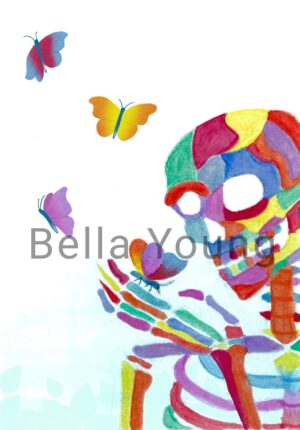
Fragility
- From her art series, “Butterfly and Bone”. A mixed media artwork inspired by artist Bradley Theodore. Bella seeks to explore life and death using both digital artistry and traditional watercolor.
Only $10 USD (approx currency conversion)
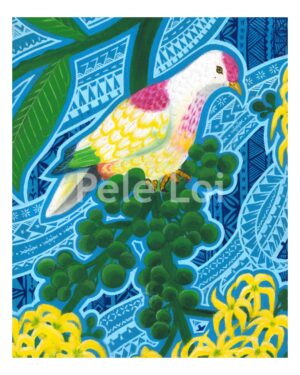
Free as a Bird by Pele Loi
This print by Pele Loi features a bird feeding in the natural Samoan environment against a bright blue background of Samoan tatau patterns.
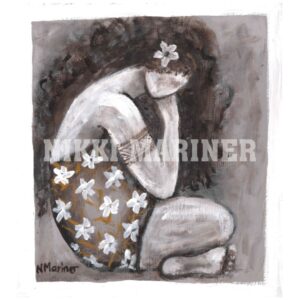
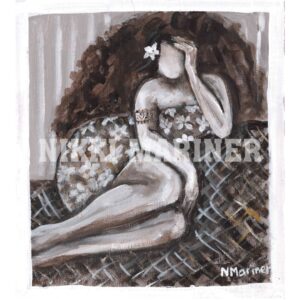
Hard To Hold
- *Available
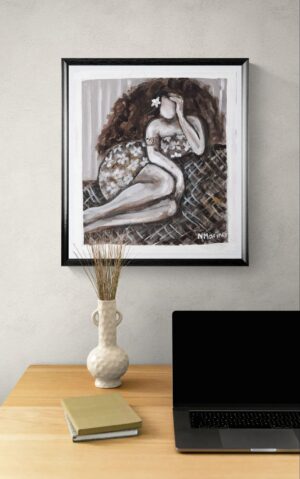
HARD TO HOLD
A contemporary, sketch-like print of a new painting by Nikki Mariner.
Hard to hold. Her hair? Her feelings? Her body? Her life?
A small introspective piece.
Not much colour, lots of texture, and strong emotional impact.
One of three in this style and theme.
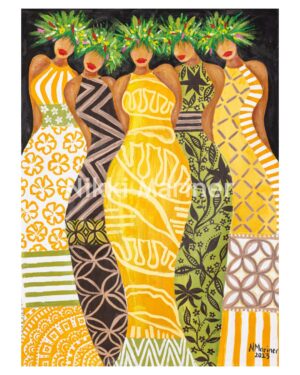
Lady Fingers | Misiluki
- I was staring at banana trees when I started painting this and deciding on a colour palette.
Yellows, greens and browns. Not colours I usually use but you can’t argue with nature’s beauty.
Then the title just seemed so obvious and perfect.
Misiluki is Samoan for Lady Finger bananas.
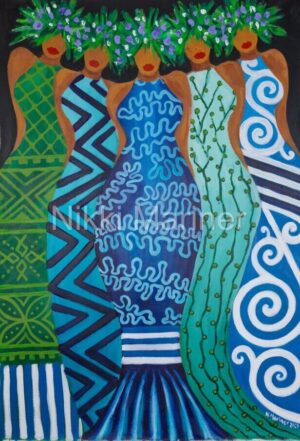
Lady Fingers. Five digits on a hand and five is the number of sisters I paint over and over again.
This bunch of five sisters are all grown up.
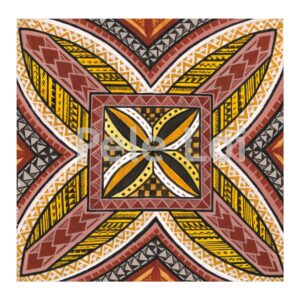
Mamanu by Pele Loi
This print features traditional Samoan patterns and symbols found in our siapo (tapa cloth) and tatau (tattoos).